Documentation
Reference
-
User Guide
The complete Keepalived manual covers installation, configuration and the load balancing and high availability concepts.
-
Configuration man page
The
keepalived.confman page is the exhaustive reference for every keyword. The core team maintains it as part of each release. -
Release Notes
Detailed notes for every release, with the changes, fixes and new features that each version brings.
-
ChangeLog
The full historical ChangeLog records the project evolution back to the very first versions.
Software design
Keepalived is written entirely in pure ANSI/ISO C. The software is built around a central I/O multiplexer that provides a real time networking design. The main goal is a clean modularity between every element, so a core library removes code duplication, and the code stays safe and auditable to guarantee production robustness and stability.
To reach that robustness, the daemon splits into up to four processes. A minimalistic parent process monitors its forked children, while one child runs the VRRP framework, another runs the health checkers along with the IPVS configuration, and a third runs the BFD stack. Each child owns its scheduling I/O multiplexer, which keeps jitter low because VRRP and BFD timing are more critical than health checking. The split also keeps the health checker isolated from foreign libraries, so it cannot disturb the more sensitive VRRP and BFD paths.
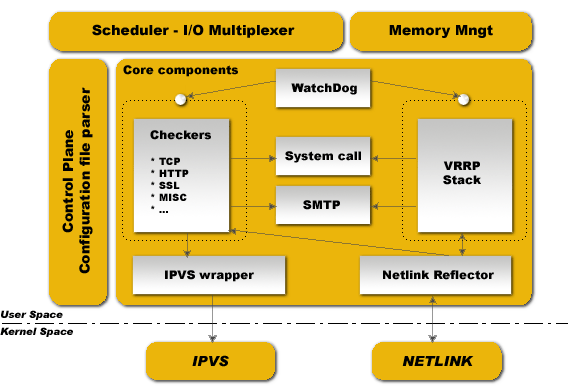
The parent monitors the children through a framework called the watchdog. Each child opens a Unix domain socket, and the parent connects to it during bootstrap and then sends periodic hello packets. When the parent can no longer deliver a hello packet, it simply restarts the child. The running process list therefore looks like this:
  PID
  111  keepalived       <-- parent process, monitors children
  112   \_ keepalived   <-- VRRP child
  113   \_ keepalived   <-- health checking child
  114   \_ keepalived   <-- BFD child
This design brings two benefits. Because hello packets travel through the I/O multiplexer, the watchdog can detect a deadlock in a child scheduler. Because the parent also relies on SysV signals, it can detect a child that has died and bring it back.
Components
- Control plane
- Configuration lives in
keepalived.conf. A compiler style parser walks a keyword tree that maps each keyword to a specific handler, and a central recursive function reads the file and translates it into an internal memory representation. - Scheduler and I/O multiplexer
- Every event is scheduled in the same process around a central
epollevent loop. POSIX threads are not used. The framework provides its own thread abstraction optimised for networking. - Memory management
- Generic allocation, reallocation and release helpers run in a normal mode or a debug mode. The debug mode tracks allocations to eradicate memory leaks, protects against buffer under-runs and keeps buffers length fixed to prevent overflows.
- Core components
- Common libraries shared across the whole code base, including HTML parsing, linked lists, timers, vectors, string formatting, buffer dumps, networking helpers, daemon and PID handling and a low level TCP layer.
- Health checkers
- One of the main Keepalived functions. Checkers test whether a real server is alive and then add it to or remove it from the IPVS topology. The stack uses a fully multi threaded finite state machine and runs in its own monitored process.
- VRRP stack
- The other main function. It implements the full IETF RFC5798 standard with extensions for LVS and firewall designs, the sync group extension that keeps routing paths persistent after a takeover, and legacy IPSEC-AH with MD5-96 to secure protocol adverts. The VRRP code can run without LVS support.
- BFD stack
- An implementation of Bidirectional Forwarding Detection (RFC5880). The VRRP process can use it to track a VRRP instance, and the health checker process can use it to test a real server. It runs in its own monitored process.
- Netlink reflector
- Keepalived keeps its own representation of the network interfaces. It sets VRRP virtual IPs through Netlink, and it listens to Netlink broadcasts so any interface event, even one triggered by another program, is reflected into its internal data.
- IPVS wrapper
- Translates the internal data representation into IPVS rules and sends them
to the kernel through
libipvs, which keeps the integration generic. - System call and SMTP
- A forked process can launch an external script during a state transition without disturbing the global timer. The SMTP framework notifies administrators about health checker activity and VRRP transitions, and it can feed any other notification system.
Guides and papers
Some of these documents are historical and may be out of date, yet they remain useful to understand the project history and the design rationale.
- LVS-NAT + Keepalived HOWTO
- Keepalived LVS-NAT director, ProxyArp and firewall HOWTO
- Media link failure detection for modern routers (PDF)
- IPVS syncd strong authentication extension (PDF)
- draft-ietf-vrrp-ipsecah-spec-00
- Keepalived internals for LVS-HA using VRRPv2 (PDF, out of date)
- Keepalived User Guide (PDF, deprecated)
- LVS + Keepalived Chinese application document (PDF)
- JRES 2011 presentation by Alexandre Simon: paper and slides (PDF, French)